
Equity Policy
If you have any questions about TSMS Equity Policy, please contact Mrs. Pagozalski, Assistant Principal Curriculum, at pagozalskip@tsmas.org
Transportation Policy
Bus Transportation is provided for students living outside the 2-mile zone on a first-come first-served basis. The 2-mile zone is determined by drawing a radius line from the entrance of the school to the student’s home or entrance of their subdivision. We use primarily “Area Stops” where parents will need to drive their students and wait for the bus to arrive. Parents are required to formally request bus transportation—by submitting a Bus Transportation Request form–and be approved by the Transportation Coordinator before their student(s) may board a TSMS bus.
Students residing within the 2-mile zone are not eligible for bus transportation. Please see the 2-mile No Transportation Zone Map below if you’re not sure whether you live inside the 2-mile radius circle.
TSMS contracts with Tomahawk Transportation to operate two bus routes, designated as Red and Blue. During the AM or PM Runs, if you have a problem or emergency, please call the Tomahawk Dispatcher as he has direct radio contact with the Drivers. The Tomahawk number is: (850) 815-2626.
If you have any other question or bus-related problem, please call the TSMS Transportation Coordinator, Ms. McCalla, at 850-681-7827, Ext 140.
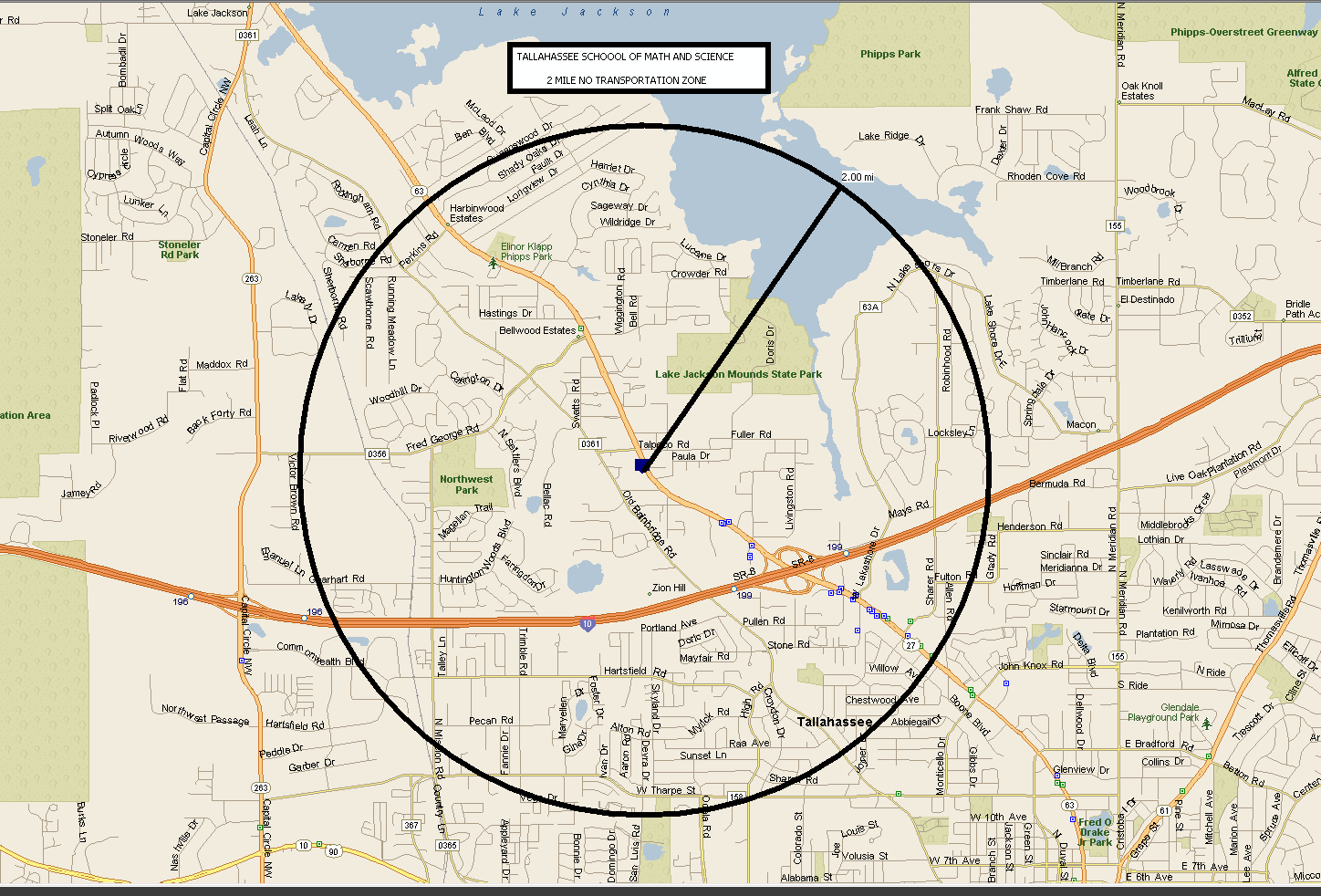
TSMS BUS TRANSPORTATION INFORMATION
According to the Florida Department of Education, students and parents are responsible for safety and proper behavior when going to and from the stop and while waiting for the bus.
More specifically: Parents are responsible for the safety and supervision of their children from the time the children leave home in the morning until they board the bus, and at the end of the day from the time the school bus departs the unloading area until the children reach their home. Please coordinate with other parents to ensure an adult is present at the bus stop every day.
It is imperative that parents or approved guardians arrive on time to drop off or pick up students at their assigned bus stop to avoid unsupervised students left in public areas. At the discretion of the driver, young children will not be left unattended at an Area Stop and may keep the child on the bus if no one meets the bus. An effort will be made to contact the parent to arrange pick up.
Always use your designated stop and discuss with your child the best route to and from the bus stop. Talk to your children about safe bus behavior and review the Bus Safety Rules & Procedures to follow.
Students may not get on or off the bus at any location other than his/her regular designated bus stop. If a situation occurs in which your child will need to get off or on the bus at another existing stop, parents or guardians must send a note to an Administrator or the Transportation Coordinator for approval in advance or early in the day. If the request is approved, the driver will be notified.
The driver has the authority to assign students to certain seats if necessary to promote order on the bus.
Misbehavior on the bus is handled separately from other discipline issues at school as outlined in the TSMS Student Handbook. The driver may issue verbal warnings and written referrals for violations of these rules. The principal (or designee) may suspend a student from riding the bus for serious rule violations or repeated minor violations.
If you have bus-related concerns or issues, please contact the Transportation Coordinator and/or arrange a conference with your driver through the school but not at the bus stop.
BUS SAFETY RULES & PROCEDURES FOR STUDENTS:
Going to the Bus Stop/ Going Home from the Bus Stop
In the morning leave your house in time to be at the bus stop at least 10 minutes ahead of the scheduled bus arrival time.
Always walk to and from the bus stop and use caution. If there is no sidewalk, walk against traffic and out of the road. Do not cut across private property. Look both ways and listen before crossing any street.
If you are late and need to cross in front of the bus, wait for the red flashing lights and the stop arm of the bus to come out. Watch for a signal from the bus driver, when to cross. Cross only when all the traffic has stopped and look left and right and left again before you cross.
DO NOT RUN ACROSS THE STREET.
In the afternoon go straight home.
At the Bus Stop
Wait for the bus away from the road. No horseplay at the bus stop. It is not safe to run, play ball or tag at the bus stop. Do not run out into the street. Do not abuse, damage or litter property while waiting for the bus. Do not talk to strangers or accept a ride from any stranger.
Line up for the bus and keep your hands to yourself.
Never walk behind a bus. Never run after a moving bus.
On the Bus
Don’t push other students while getting on and off the bus.
Take your backpack off and hold it in front of you when getting on and off the bus.
When getting on the bus or getting off the bus hold on to the handrails.
Go directly to your seat and remain seated.
Hold your backpack, lunch box or other items on your lap.
Do not place items in an area that may cause someone to trip. Keep the aisles clear.
Sit in your seat properly, so that your back touches the seat, with your feet in front of you and facing front at all times. Never kneel on your seat or sit backwards. Do not lean against the bus window.
Talk quietly with the person in your seat. Never shout to others or use profanity or inappropriate language.
Never play with the emergency exits.
Don’t stick anything out the window. Keep hands, arms, and head inside the bus at all times.
Refrain from disturbing the driver while the bus is in operation and conduct yourself in accordance to the Student Code of Conduct.
Obey the driver and listen for instructions, in case of an emergency.
Do not take things out of your backpack.
No eating, drinking or gum on the bus.
Exiting the Bus
Remain seated until the bus comes to a complete stop.
When you exit the bus hold your book bag in front of you and hold on to the handrail.
Look left and right when getting off the bus. Walk (don’t run) directly away from the bus. Stay away from the bus wheels.
If you need to cross, walk 10 ft. forward from the bus, look left and right, watch for traffic. Watch for your driver to signal for you to cross. Look left and right and left again.
In afternoon, go straight home.
You can only get off the bus at your designated bus stop.
If anything is dropped while loading or unloading, tell the driver and wait for instructions before picking it up.
Wellness Policy
Uniform Policy
 Dear parents,
You may purchase approved uniform pieces from our online TSMS store, Ibiley, and Lands’ End.
If you have any questions about the TSMS Uniform Policy, please contact Mr. Mccovery at bmccovery@tsmas.org
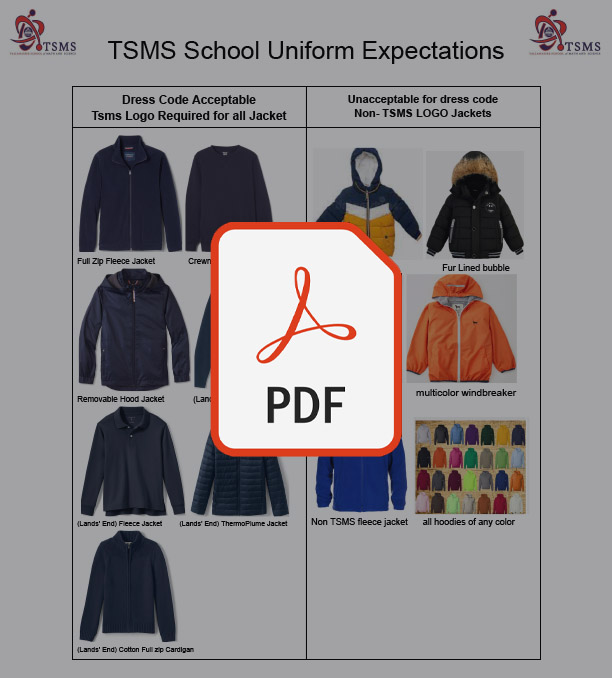

DRESS CODE
Students are expected to wear the TSMS uniform at all times and to dress and groom themselves in such a way as to reflect neatness, cleanliness, and safety. All students should dress appropriately so as not to disrupt or interfere with the educational program or the orderly operation of the school. The principal or other duly authorized school official shall determine whether any particular mode of dress, grooming, and accessories is in violation of the spirit and/or the intent of the school’s dress code policy. Students and parents are expected to honor the uniform code in order that valuable school time is not spent examining student attire to determine appropriateness. Students are not permitted to change out of their uniforms during or after school unless participating in P.E. or an after-school activity that requires non-uniform clothing.
Students who violate the uniform code will be allowed to call home for an appropriate change of clothing after obtaining administrator approval. Otherwise, a violation of the dress code will be treated as insubordination and the student will be removed from the classroom to continue academic studies. The student’s parents will be notified of this violation. Inappropriate attire jeopardizes the instructional climate and therefore, will not be tolerated.
Tallahassee School of Math and Science, standard student attire policy, “Students Attired for Education (SAFE) Act.” For TSMS.
PURPOSE—The purpose of a standard student attire policy is to provide a safe environment for students which fosters learning and improves school safety and discipline by:
(a) Encouraging students to express their individuality through personality and academic achievements, rather than outward appearance.
(b) Enabling students to focus on academics, rather than fashion, because they are able to convey a neat, serious, and studious image.
(c) Minimizing disciplinary problems because students are not distracted by clothing.
(d) Reducing the time needed to correct dress code violations through a readily available inventory of compliant attire.
(e) Minimizing visible differences between students and eliminating social pressures to wear brand-name clothing or colors to show gang affiliation, thereby easing financial pressures on parents and enhancing school safety.
(f) Creating a sense of school pride and belonging.
The schools shall implement this standard attire policy that:
(a) Applies to all students in kindergarten through grade 8 in the school regardless of individual school grade configurations.
(b) Prohibits certain types or styles of clothing and requires solid-colored clothing and fabrics for pants, skirts, shorts, or similar clothing and short- or long-sleeved shirts with collars.
(c) Allows reasonable accommodations based on a student’s religion, disability, or medical condition.
Guidelines for clarification are as follows:
Uniforms must be always worn properly while at the TSMS campus. All parents are responsible for assuring that as the student grows through the year, the uniform fits appropriately. The final decision of what is appropriate at TSMS is made by the principal or designee.
a. Students must be in complete uniform when they arrive at TSMS. All shirts must be tucked into shorts, pants, or skirts. Belts must be worn with all pants and shorts. Uniforms are expected to remain intact and appropriately worn throughout the entire day at school.
b. Students must remain in full uniform until after they leave TSMS. Shirts must remain tucked in – even after school until they leave the school campus.
c. Students who ride the bus must be in complete uniform when they get on the bus at the bus stop. Since students must be in complete uniform when they arrive, and they are not allowed to change clothes on the bus, they must already be in complete uniform as they get on the bus.
Shoes:
a. Shoes must be closed-toed dress shoes, only solid black or solid brown in color, or plain athletic shoes such as black, brown, gray, white, or navy. Birkenstock Clogs (no covered heel) in the brown or black color are also not acceptable. No special designs or patterns (checkered plaid, camouflage, etc.) or wild colors (red, yellow, pink, etc.) are permitted. Shoes must be worn at all times.
b. The emphasis regarding shoes is safety – for that reason, all shoelaces must be tied properly, all buckles fastened, and all straps must be secured or velcroed – nothing may dangle or drag from the shoe. Slippers or thin-soled shoes, thin plastic shoes, flip-flops, or open-toed shoes are not permitted.
c. Boots, Uggs, and high-heeled shoes are not permitted – Heels on shoes may not be higher than one (1) inch. Roller shoes, “wheelies” or shoes with wheels are not permitted.
Pants or Shorts:
a. Pants or shorts must be either khaki or navy blue in color with the TSMS logo embroidered. All pants and shorts must have belt loops, and a belt must be worn through all the loops and fastened appropriately. Front pockets must be side seam pockets and back pockets must be sewn inside the pant or shorts – no outside pockets, patch pockets, or additional pockets are permitted. Pants or shorts may not have rivets or brads, split seams at the bottom of the legs, or flaps on the pockets. Material may not be suede or corduroy – it must be 100% cotton or a cotton/polyester blend that is wrinkle resistant.
b. Pants or shorts must be worn properly at the waist and not sag below the top of the hips. Pants or shorts may not be rolled up or folded up. Shorts must be at least fingertip length and not longer than the top of the knee when standing. Calf-length, Capri-style or Knee-Knocker pants are not acceptable. Skintight and close-fitting clothing (pants, shorts) are not permitted Students wearing the top of their pants or shorts below their buttocks will be given a Disciplinary Referral Form for improper exposure (see 2.25)
c. Athletic shorts are not permitted. Athletic-type shorts, such as those used for biking, are not permitted. Shorts must align with the tip of your middle finger when your arms are at your side and cannot be longer than the top of your knee when standing – no “long shorts” are permitted.
Skirts or Skorts:
a. Skirts or skorts must be either khaki or navy blue in color with the TSMS logo embroidered. All skirts and skorts must not be made of jeans, suede, or corduroy material. No splits are permitted in the skirt at all. Skirts must be no shorter than 2 inches above the knee. Skirts and skorts must not be rolled or folded at the waistband – students wearing their skirts or skorts too short will be given and Disciplinary Referral Form for improper exposure (see 2.25).
b. Pants, jeans, pajama bottoms, or other apparel must not be worn under the skirt or skort. For modesty purposes, shorts may be worn under the skirts or skorts, however, long pants, jeans, pajama bottoms, or other apparel that shows below the skirt or skort must not be worn at any time.
Top Options:
a. Dress Shirts and blouses must be oxford cloth in white or light blue with button-down collars. Dress shirts and blouses may either be short sleeve or long sleeve and requires TSMS school initials/logo on the pocket. All shirts and blouses must be tucked in (able to see the belt/waistband) at all times to the shorts, pants, skirt, or skort the student is wearing.
b. Knit shirts must be pique fabric in red, white and navy blue, and the school logo is required. These knit shirts can be either short sleeve or long sleeve. All knit shirts must be tucked in (able to see the belt/waistband) at all times to the shorts, pants, skirt, or skort the student is wearing.
c. Sweatshirts must be navy blue and the school logo is required. The sweatshirt is an economical alternative when students need to have additional warmth. When wearing a sweatshirt, the student must still be wearing another TSMS shirt underneath the sweatshirt – the sweatshirt cannot be worn alone. A sweatshirt may not be worn (tied) around the waist. No long sleeve undershirts are allowed to show beneath Uniform Top.
d. Jackets must be navy blue, fleece-lined Jersey jackets – the embroidered school logo is required. These jackets may be worn to school, but they are not permitted to be worn in the school building – once in the building the jacket must be taken off and placed in their locker.
Accessories:
a. Belts must be leather, braided leather, or fabric in the solid colors of black or brown. Grommets, brads, or excessive ornamentation on the belt is not permitted. Belts are required to be worn properly with all pants or shorts – this means that the belt must go through all the belt loops on the pants, be properly fastened or buckled, and the “end” of the belt must not be allowed to hang down (it must also go through the loops if there is excess). The belt must also be tightened enough to prohibit the student’s pants or shorts from sagging below the hips.
b. Socks, stockings, tights, or hoses may only be in solid school colors. Clear or skin-colored hose are also acceptable. Fishnet or other patterned stockings or hoses are not permitted. Stockings, tights, or hoses must cover the full length of the student’s legs and feet – leg warmers/leggings are not permitted.
Miscellaneous Guidelines:
a. Clothing should be neat and clean.
b. Clothing may not be worn inside out or backward.
c. Undergarments must not be exposed.
d. Hair, face, body paint, stickers, and tattoos are inappropriate for school and not permitted.
e. Athletic outfits are not permitted in the school building, except in P. E. classes and Dress Down Days
f. Cosmetics and/or make-up should be age-appropriate, appropriate for school, and not attract undue attention.
g. Clothing with rips, tears, holes, or frayed edges is considered inappropriate for school.
h. Jewelry and accessories including but not limited to necklaces, chokers, bracelets, rings, earrings, etc. should be appropriate for school, not excessive, and should not attract undue attention or pose a safety risk. The final decision will be made by the principal or designee on the appropriateness of the accessories. Piercing other than earrings are prohibited. Earrings must be school appropriate and not pose a safety risk. Jewelry that may be considered a danger to the student (large hoop or long in length) will be at the discretion of the principal or designee.
i. Extreme hairstyles and hair colors are not permitted (examples: Mohawk haircuts; designs, words, or names cut into the hair, blue, purple, pink, green, red, burgundy, etc.). Hair coloring other than standard frosting or natural highlighting is not permitted. Hair should not attract undue attention. The hair in question will be left to the discretion of the principal or designee.
j. The only hair accessories authorized for use for students at TSMS are plain, solid in color navy, red, or white hairbands, 3 inches or less in width. Examples of not permitted accessories: Hats, caps, curlers, headscarves, bandanas, doo-rags, pick combs, combs, brushes, sweatbands, flower crowns, embellished hairbands, knitted hairbands, bowknot hairbands, turban hairbands, ear hairbands, Alice hairbands, polka dots hairbands, glittered hairbands, scarfs hairbands, ponytail hairbands, floral hairbands, chains, sunglasses, tennis skirts, gloves, arm warmers, and coats are not to be worn during school hours. Students may be allowed to wear sunglasses, hats, or other sun-protective wear while outdoors during school hours, such as when students are at recess. Hair accessories in question will be left to the discretion of the principal or the designee.
k. Reasonable accommodations will be in place based on a student’s religion, disability, or medical condition.
l. Clothing that is revealing, such as short mini-skirts, short-shorts, tank tops, loosely fitting, low-cut blouses or halter tops, mesh shirts, or shirts exposing the midriff are not to be worn to school. Sleeveless shirts are not allowed. (Mainly applies to non-uniform days at school). Shirts must be worn buttoned up to second from the top.
m. All t-shirts must be in good taste (no suggestive wording/illustration or lettering/pictures glorifying death/ violence, camouflage, or anything offensive or advertisements for items which are illegal for elementary and middle school students – i.e., alcohol and tobacco products, etc.). (Mainly applies to non-uniform days at school). Administration-approved school spirit t-shirts may be worn in lieu of a school uniform polo shirt.
n. All outside coats and jackets or hooded apparel may not be worn on campus. –All outside coats and jackets or hooded apparel must be put in the student’s locker or backpack immediately upon entering the school building. The TSMS uniform includes an optional sweatshirt or zippered fleece for those students who need to have additional layers to remain warm.
o. Silly Bandz, Crazy Bandz, rubber bands, colorful bracelets, and Jelly bracelets are not permitted.
p. Gold/silver mouthpieces or “Grillz” are not permitted.
q. Unnatural colored contact lenses are not permitted unless medically prescribed.
r. Camouflage uniforms are only permitted for the Civil Air Patrol Cadets. Boots are only allowed on the days established per the squadron. Wearing non-uniform items any other day will be a violation of the dress code.
s. Leggings may not be worn as pants.
PURCHASING THE SCHOOL UNIFORMS
All uniform pieces require the school logo or initials and must be purchased through the school’s vendor. Currently, the available stores are landsend.com and frenchtoast.com, (subject to change) Contact the school for more information.
Should a student’s uniform not comply with the uniform dress code, they will be considered in violation. Students who violate the uniform code will be allowed to call home for an appropriate change of clothing after obtaining administrator approval. The student will be isolated in the Intervention Room until an appropriate change of uniform clothing is brought to school by the parent/guardian. The student will also receive conduct points for a uniform violation.
GIRLS | ALL GRADES |
BOTTOMS | |
SKIRT | STYLE #3951 (kick-pleat skirt), PLAID #60 (T.S.M.S. school initials) |
SKORT | DOUBLE WRAP PLEATED in KHAKI or NAVY (T.S.M.S. school initials) |
SHORTS | HAKI or NAVY BLUE, with cuff (T.S.M.S. school initials) |
PANTS | KHAKI or NAVY BLUE (T.S.M.S. school initials |
| TOPS |
BLOUSE | OXFORD CLOTH in WHITE or Light Blue with S/S or L/S (T.S.M.S. above pocket) |
KNIT SHIRTS | REQUIRED: PIQUE in NAVY BLUE S/S or L/S (school logo required) OPTIONAL: PIQUE in RED, WHITE S/S or L/S, (school logo required) |
SWEATSHIRTS | NAVY BLUE (logo required) |
| ACCESSORIES |
SHOES | CLOSED TOE DRESS SHOES or ATHLETIC SHOES |
JACKET | ZIP UP NAVY JACKET (UNIVERSAL JERSEY) in NAVY BLUE (with Embroidered school logo required, No Hood |
BOYS | ALL GRADES |
BOTTOMS | |
SHORTS | KHAKI or NAVY BLUE (school initials) |
PANTS | KHAKI or NAVY BLUE (school initials) |
| TOPS |
DRESS SHIRTS | OXFORD CLOTH WITH BUTTON-DOWN COLLARS in WHITE or LIGHT BLUE with Short or Long Sleeves (school logo required) |
KNIT SHIRTS | REQUIRED: PIQUE in NAVY BLUE S/S or L/S (school logo required) OPTIONAL: PIQUE in RED or WHITE S/S or L/S, (school logo required) |
SWEATSHIRTS | NAVY BLUE (with logo required) |
| ACCESSORIES |
SHOES | CLOSED TOE DRESS SHOES or ATHLETIC SHOES |
BELT | STRECH or BRAIDED BELT in BLACK or BROWN |
JACKET | ZIP UP NAVY JACKET (UNIVERSAL JERSEY) in NAVY BLUE (with Embroidered school logo required, No Hood) |
BOYS/GIRLS | ALL GRADES ATHLETICS ATTIRE |
BOTTOMS | |
SHORTS | MESH SHORTS, BLUE (school initials/ Logo) |
SWEATPANTS | NAVY BLUE, SOFFE (school initials/ Logo) |
T-SHIRT | HEATHER GRAY (school Athletics logo required) |
Progressive Discipline
If you have any questions about TSMS Progressive Discipline Policy, please contact Mr. Mccovery, Dean of Discipline, at mccoveryb@tsmas.org .
Grievance Reporting Flow Chart